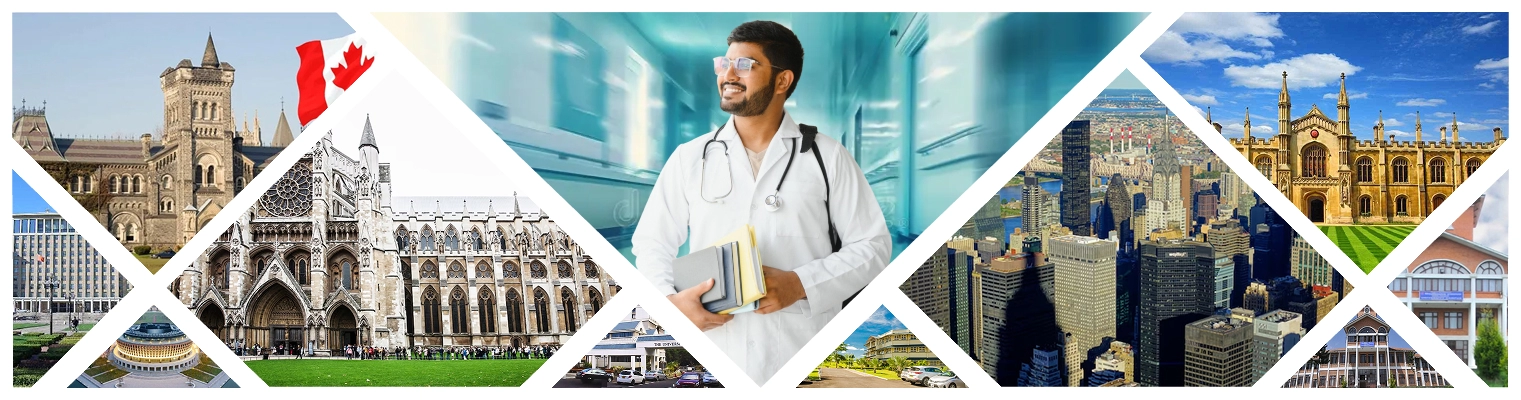

Why Consider MBBS in Canada?
For Indian students with a dream to become doctors and explore global medical careers, Canada presents a compelling option. The country offers world-class medical education, strong infrastructure, research oriented training and globally recognised degrees. But it is also different from the typical “MBBS after 12th” route in India, which means you must be well informed to make the right decision.
What makes Canada attractive:
The medical schools in Canada — offering the Doctor of Medicine (MD) rather than MBBS — are highly regarded globally. For Indian students, a Canadian MD degree opens doors in multiple countries and credentials that are recognised by major medical councils.
Excellent quality of life, multicultural environment, safe campuses and good research facilities add to the appeal.
Potential for post-graduation options, though one must be aware of the full pathway including residency and licensing.
If you plan to return to India, certain Canadian medical qualifications may be considered under Indian regulatory rules. For example, the rules state that foreign medical graduates from countries like Canada, UK, USA may be exempt from certain screening tests.
Important caveat:
However, “MBBS in Canada” is not the same as the Indian MBBS model. In Canada, you cannot directly enrol after 12th; you will typically need an undergraduate degree first, then apply to a medical school.
Moreover, seats for international students are extremely limited, competition is fierce, and cost is high. Many Indian aspirants must consider whether this route fits their budget, time-horizon and career goal.
With Meer Education and Travel Solutions, you’ll receive transparent counselling: pros & cons, alternative paths, and realistic assessment of your profile.
Understanding the Structure of Medical Education in Canada
To plan properly, you must understand how medical education works in Canada—because it differs from many other countries and the Indian model.
Key structural elements:
Canadian medical schools generally award the Doctor of Medicine (MD) degree, not MBBS. Many resources refer to “MBBS in Canada” but the correct equivalence is MD.
You cannot directly apply after 12th grade. Most Canadian schools require applicants to have completed an undergraduate bachelor’s degree (3–4 years) or at least significant university coursework in science/biology to be eligible for MD admission.
After admission into MD program, you complete approximately 4 years of academic and clinical training, followed by residency (which may run 2–5 years depending on speciality).
For Indian return-to-practice considerations, you must ensure the curriculum, internship/clinical exposure meets Indian regulator requirements.
Typical timeline for an Indian student:
Complete Class 12 (PCB) →
Complete a Bachelor’s degree (3–4 years) →
Sit the MCAT (Medical College Admission Test) and other requirements →
Enter a Canadian MD program (4 years) →
Complete residency/training →
Obtain licensure and/or practise return.
Implications for Indian learners:
It means a longer timeline (often 7–10 years from 12th grade to independent practice) compared to some other foreign MBBS routes that admit after 12th.
Cost accumulates—not only in medical school but also undergraduate years, living expenses, licensing, etc.
Ensure you have clarity on licensing back in India if you wish to practice there; the Indian regulator’s guidelines must be followed.
By understanding this structure, you can make an informed decision whether Canada suits your ambition or if other destinations fit better.
Eligibility Requirements and Admission Criteria for Indian Students
Meeting eligibility and admission criteria is the first major hurdle. Indian students aspiring to pursue medical education in Canada must satisfy rigorous requirements.
Academic eligibility at a glance:
You must have completed 10+2 (or equivalent) in Physics, Chemistry, Biology (PCB) and English with good marks. Some sources suggest minimum 70%+ in PCB for Indian students.
You will then need a Bachelor’s degree (Preferred: Life Sciences, Biology, Biotechnology, or sometimes other science majors) if you aim for MD.
Suitable GPA in undergraduate study or completion of required coursework is expected.
Valid English proficiency: IELTS (often 6.5–7.0) or TOEFL (90+).
MCAT (Medical College Admission Test) score is often required by many Canadian medical schools. Some universities may allow alternative eligibility but MCAT is the norm for international students.
Indian students must also qualify NEET (UG) if they intend to return to India and practise, because the Indian regulator (NMC) mandates foreign medical graduates to satisfy NEET or equivalent/exit screening.
Other admission criteria:
Letters of Recommendation (LORs), Personal Statement, Interviews may form part of applications.
Some schools might prioritise Canadian citizens or permanent residents; international seats are very limited. > “Many of them only admit Canadian citizens…
Financial proof: International applicants must demonstrate ability to fund tuition + living expenses.
Visa/Study permit: Secure student permit for Canada, with required documentation and proof of funds.
Why this matters:
If you don’t meet these criteria — for example lacking a bachelor’s degree, weak MCAT score or insufficient funds — your admission chances will be extremely low. Since Canada’s medical schools are highly competitive, with limited international seats, you must present a strong profile.
At Meer Education and Travel Solutions, we assist you in reviewing your eligibility, strengthening your profile (for example via research, volunteering, language prep), and guiding you through application planning.
Cost of Medical Education in Canada & Financial Planning
Cost is a major factor when considering medical education in Canada. Tuition fees are high, living costs add up, and you must plan for licensing/residency too. A realistic budget is essential.
Tuition fees:
According to recent data, tuition fees for Canadian MD programs for international students can range CAD 26,000 to CAD 96,000 per year depending on university.
Converted roughly into Indian rupees, depending on exchange rate, this could be ₹15-70 lakhs per year. For example, one source indicates fees of ₹51.35 lakhs per year at University of Toronto for international students.
Some sources put typical annual cost for Indian students in Canadian medical programs around INR 38-60 lakhs per year.
Living and miscellaneous expenses:
Accommodation, food, transport, health insurance, books, personal expenses must be accounted.
For example, a source estimated living cost around INR 25 lakh per year for international students in Canada.
Also factor in costs for MCAT preparation, travel (India-Canada), visa fees, and potential licensing/residency costs after graduation.
Financial aid & scholarships:
Several Canadian universities offer scholarships to international students based on merit or need.
However, for international students in medical programs the scholarships may be extremely limited and competition is high.
Return on investment (ROI):
While the initial cost is very high, the medical degree from Canada carries strong global recognition.
However, consider your intended practice country, licensing requirements, and whether you’ll remain in Canada or return to India. If you plan to return to India, check whether the program will be eligible and what additional exams you must clear (e.g., FMGE/NExT).
Because of high cost + longer timeline, many Indian students compare Canada with other lower-cost destinations.
At Meer Education, we help you prepare a detailed budget sheet: tuition + living + contingencies + licensing/residency costs, so your family can plan realistically.
Top Canadian Medical Schools for Indian Students
Selecting the right medical university is crucial because international seats are limited and competition is severe. Here are some of the top Canadian medical schools frequently chosen by Indian students:
Notable institutions:
University of Toronto – Toronto, Ontario. Highly ranked globally. Tuition for international students listed approx. ₹51.35 lakhs/year in one source.
McGill University – Montreal, Quebec. One of the oldest medical schools in Canada.
University of British Columbia – Vancouver, BC. Highly regarded for medical education and research.
McMaster University – Hamilton, Ontario. Known for innovative curricula.
Queen’s University – Kingston, Ontario. Good option for international applicants.
University of Alberta – Edmonton, Alberta.
Dalhousie University – Halifax, Nova Scotia. Named in some lists for accessible fee-structure.
Key points when choosing:
Check whether the university admits international students to medical (MD) programme. Some only admit Canadian citizens or permanent residents. For example: “Only a few accept international students; many schools don’t even look at international applicants.”
Check fee structure for international students.
Review whether the school meets Indian regulator requirements if you plan to return to India (e.g., course duration, internship, English medium).
Compare living cost in city (Toronto/Vancouver more expensive) and undergraduate/medical path timeline.
At Meer Education and Travel Solutions, we maintain updated data sheets of Canadian medical schools, eligibility for international students, seat quotas, fees and help you compare options aligned to your budget & goals.
Application Process: How to Apply for MD in Canada
Applying to Canadian medical school requires careful planning. The competition is fierce, processes are detailed, and deadlines are strict. Here’s an outline of the usual steps.
Step-by-step application process:
Undergraduate preparation
Ensure you have completed or are enrolled in a Bachelor’s degree (often 3-4 years) with strong academic record.
Undertake extracurriculars, research, volunteering (medical exposure) to strengthen profile.
Entrance tests
Prepare for MCAT (Medical College Admission Test) — many Canadian medical schools require MCAT scores for international students.
Secure required IELTS/TOEFL score for language proficiency.
Research universities & deadlines
Identify universities that accept international applicants. Review their quotas for international students, application fee, required documents, interview process.
Prepare application packet
Transcripts (Bachelor’s + 12th grade), MCAT score, language score, letters of recommendation, personal statement/essays, CV/resume, sometimes CASPer or other assessments.
Submit application
Via university’s portal— often during listed application window (e.g., August-October for next intake).
Interview/Selection
If shortlisted, you may be contacted for interview (online or in person depending on location).
Offer letter
If accepted, you receive an offer letter (conditional or unconditional). Review fee, scope, scholarship (if any), and combinable conditions.
Secure finances & visa
Pay deposit if required. Apply for Canadian student permit (Study Visa), demonstrate funds, accept terms.
Also, ensure you meet the immigration eligibility and maintain student status.
Pre-departure & arrival
After visa, plan travel, housing, orientation in Canada, health insurance, campus registration.
Key advice:
Because international admission is so competitive in Canadian medical schools, build a strong profile (academic + extracurricular + research + volunteering).
Start early: undergraduate status, MCAT prep, research involvement.
Keep backup options: other countries, allied health programmes, more affordable destinations.
With support from Meer Education and Travel Solutions, you get timeline checklists, application tracking, document guidance, visa assistance and pre-departure orientation.
Recognition & Licensing: What Happens After Graduation
One of the most critical aspects of studying medicine abroad is evaluating recognition and licensing – both in Canada and if you intend to practise elsewhere (e.g., India).
Recognition in India:
The Indian regulator, National Medical Commission (NMC) has stipulated guidelines for foreign medical graduates. Students must clear the FMGE (Foreign Medical Graduates Examination) or eventual NExT (National Exit Test) to practise in India.
Ensure the university and programme you choose meets Indian criteria: course duration at least 4.5 years (54 months), internship of 12 months, content must include key medical subjects.
Recognition in Canada & Licensing:
After MD in Canada, for practising as a physician you typically need to complete residency training in Canada and pass licensing exams.
Note: Many Canadian medical schools have quotas favouring Canadian citizens/permanent residents for residency or first choice positions. The competition for international graduates is very high. > “Even if you get into a medical school here as an international student […] the chance of residency is very low unless you are permanent resident.”
Also accreditation frameworks have changed: Canada ended joint US-Canada accreditation and adopted full Canadian accreditation framework as of October 2025.
Completing MD in Canada does not guarantee immediate practice anywhere. You must plan for residency and licensing. If you intend to return to India, you must fulfil Indian regulatory criteria. If you intend to stay in Canada, you must be aware of residency match competitiveness and immigration status.
Meer Education and Travel Solutions guides you through licensing pathways, return-to-India options, residency guidance, and how to choose a programme that aligns with your career goal.
Advantages & Challenges of Studying Medicine in Canada
Advantages:
High quality medical education, strong research infrastructure, globally respected degree.
Safe, multicultural countries and improved quality of living for students.
English-medium instruction (or bilingual English/French) facilitates Indian students’ transition.
Potential access to post-study work permits, possibilities for global career mobility.
Challenges:
Pathway complexity: Longer route (undergraduate + MD + residency) compared to other countries.
Highly competitive: Many international applicants, limited seats, preference to domestic (Canadian) students. > > “Seats for international students are extremely limited … international students may only be a few each year.”
High cost: Tuition + living costs are significant. Fees may run into INR 40-60 lakhs/year for international students.
Licensing & practice uncertainty: After graduation, securing residency and licensure is difficult for internationals; return to India needs fulfilment of screening exams.
Visa/immigration risk: Recent tightening of Canadian student permits and stricter immigration rules for Indian students raise extra caution. For example, Canada has seen heightened rejections of Indian student permit applications.
Balanced perspective:
If you have strong academics, ability to fund the long path, and intention either to work in Canada or accept the full pathway, then Canada can be very rewarding. But if your budget is limited and you want a quicker route, you may want to compare other destinations. With Meer Education and Travel Solutions, you can evaluate both advantages and risks, align them with your career goal and budget, and decide accordingly.
Cost-Benefit Analysis: Is MBBS in Canada Worth It for Indian Students?
Because of the high costs and longer timeline, Indian students must ask: does it make sense financially and professionally?
Cost elements:
Undergraduate Bachelor’s degree cost + MD tuition + living expenses for many years.
Additional costs for licensing exams, residency application, travel, training.
Because international seats are limited, even admission to MD means you may have to wait or face extra hurdles.
Potential benefits:
Strong brand value of Canadian medical degree.
Global recognition, possibility for research, higher earning potential.
Possibility of practising in Canada (subject to residency) or returning to India with a strong credential.
Compare with alternatives:
Many Indian students consider other countries (Nepal, Kyrgyzstan, China, etc) where admission is after 12th, timeline shorter, cost lower — but recognition/licensing may have additional hurdles.
So the “worth” depends on your budget, time-horizon, career ambition (Canada/local/India), willingness to take risk and long path.
For example:
If you invest Indian rupees 1.5-2 crore (over many years) for Canadian medical education, but later cannot secure residency or licensure, your ROI may be lower than expected. On the other hand, if you fully complete residency and practise in Canada, return on investment is high.
Meer Education and Travel Solutions helps you map this cost-benefit for your profile — with budget sheets, timeline projections, risk assessment and back-up plans.
How Meer Education and Travel Solutions Supports You
Choosing to study medicine in Canada is a major life decision. With the right support, you can reduce risks, plan better and increase your chances of success. At Meer Education and Travel Solutions, we provide end-to-end guidance.
Our service offerings:
Profile evaluation: We assess your academic records, extracurriculars, budget, timeline and guide you whether Canada is viable for you.
University and programme shortlisting: Based on your ambition, budget, we help you shortlist Canadian medical schools that may allow international admissions and fit your criteria.
Application support: Help with MCAT preparation strategy, document compilation, personal statements, letters of recommendation, English test prep (IELTS/TOEFL).
Financial planning: Prepare budget sheets for undergraduate + MD years, living costs, visa/licensing costs, offer cost-benefit analysis.
Visa and immigration counselling: Assist with Canadian student permit, demonstrating funds, document readiness; also keep you updated on visa/immigration policy changes.
Pre-departure and arrival assistance: Housing, travel bookings, campus orientation, connecting with Indian student networks in Canada.
Post-admission check-ins: Guidance during your undergraduate/MD journey, help with licensing/preparation if you plan to return to India or stay in Canada.
Back-up planning: If Canada doesn’t work out, we help you explore alternative destinations or allied health programmes so your time isn’t wasted.
By partnering with Meer Education, you get professional support to navigate a complex path, reduce surprises and focus on your goal — becoming a doctor.
Frequently Asked Questions (FAQs)
Here are some of the questions Indian students commonly ask about studying medicine in Canada — along with answers to help clarify.
Q1. Can Indian students study MBBS in Canada right after 12th grade?
A: No. Canadian medical schools do not generally admit students right after 12th grade as is possible in India. You first need to complete a Bachelor’s degree (3-4 years) and then apply to MD programme.
Q2. What exams are required for admission to Canadian medical school?
A: Typically: a strong undergraduate academic record, MCAT (Medical College Admission Test) score, IELTS/TOEFL for English proficiency, plus other documentation (LOR, personal statement). NEET is required by Indian students for Indian eligibility but not by Canadian universities themselves.
Q3. What is the cost of studying medicine in Canada for Indian students?
A: The cost is high. Tuition can range from CAD 26,000 to CAD 96,000 per year (depending on university) for international students. Converted to INR, this could mean ₹15-70 lakhs per year or more. Living expenses add further.
Q4. Will the Canadian medical degree be recognised in India?
A: It can be, provided you satisfy Indian regulatory conditions (such as course duration, internship, etc) and pass licensing exams like FMGE/NExT if needed.
Q5. Is it easy for international students to get admitted in Canadian medical schools?
A: Unfortunately, not. Many schools require Canadian citizenship/permanent residence, and for international seats the competition is extremely tough. > “Many of the few that do accept international students… seats maybe 0.5%.”
Q6. After obtaining MD in Canada, can I practise there or in India?
A: To practise in Canada you’ll likely need to secure residency training and pass licensing exams. To practise in India you must meet NMC foreign graduate criteria, clear FMGE/NExT and register with a state medical council.
Q7. What are the major challenges of the Canada route for Indian students?
A: Key challenges: long timeline (undergraduate + MD + residency), high cost, limited international seats, licensing/residency uncertainty post-graduation, recent visa/immigration tightening for Indian students. For example Canada has increased study permit rejection rates for Indian applicants.
Q8. Are there scholarships for medical study in Canada for international students?
A: Yes, some but very limited. Indian students must actively search and apply early.
Q9. What about language of instruction and living in Canada?
A: Most medical schools in Canada teach in English (though some provinces are bilingual English/French). You’ll need IELTS/TOEFL. Living in Canada means you must budget for housing, food, transport, health insurance, and adjust to immigrant student life.
Q10. How can Meer Education and Travel Solutions help me on this path?
A: We provide end-to-end personalised support: profile evaluation, university shortlisting, application guidance, financial planning, visa support, pre-departure orientation, on-ground assistance in Canada, and licensing/residency planning if needed.